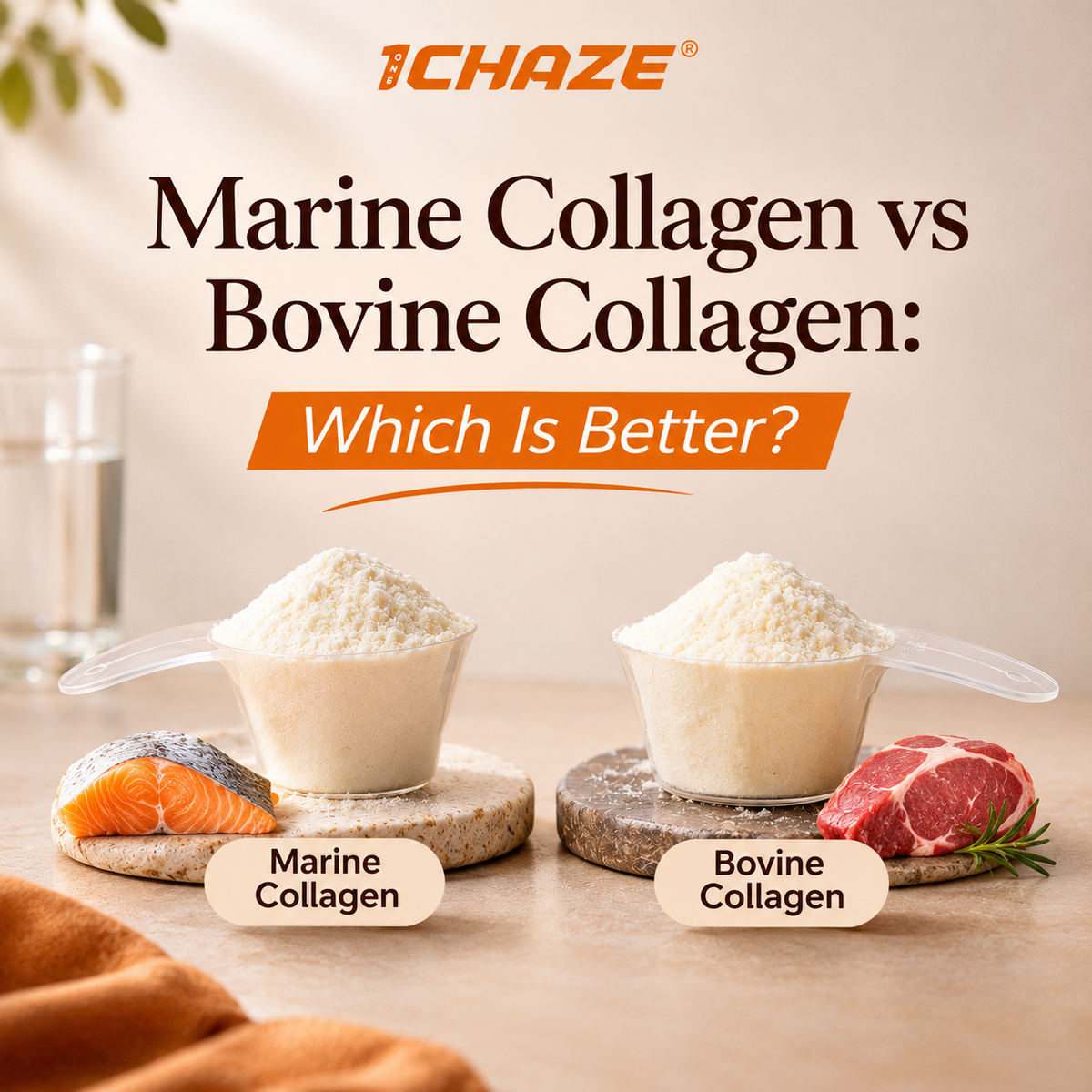
Look in any supplement section today, and you'll see that there are 2 types of collagen vying for your attention: one coming from fish and the other from cow. Both offer improved skin, improved joints and improved hair and they are packaged in nearly the same tubs. So the question people keep typing into search bars is a fair one. When it comes to marine collagen vs bovine, is there a real winner, or is it mostly marketing?
The honest answer is that the two are more alike than their labels suggest, but they are not interchangeable. The source leads to a change in the collagen type, the particle size and the ability to use the product. The differences are explained in plain words in this guide, which enables you to select the best type for your body, your diet and your goals.
What collagen is, and why it comes from fish and cattle
Collagen is the protein which is the most abundant in your body. It makes up the supporting structure of skin, tendons, ligaments, bones and cartilage. Your body produces it in slightly smaller quantities over the years, starting from the mid-20s, which is why skin becomes less elastic and joints lose their firmness as you age.
Supplements try to give your body the building blocks it needs. Manufacturers take collagen-rich by-products, break them down into small peptides through hydrolysis, and sell the result as a powder. Fish skin and scales supply marine collagen. Cattle hide and bones supply bovine collagen. Same protein family, different starting material.
Bovine vs marine collagen at a glance
|
Comparison
|
Marine collagen
|
Bovine collagen
|
|
Source
|
Fish skin and scales
|
Cattle hide and bones
|
|
Main collagen types
|
Type I
|
Type I and Type III
|
|
Peptide size
|
Typically smaller
|
Typically larger
|
|
Common focus
|
Skin, hair, nails
|
Skin, joints, muscle recovery
|
|
Taste and smell
|
Neutral in good products
|
Neutral to slightly meaty
|
|
Suitable for
|
Pescatarians, those avoiding beef
|
Those without fish allergies
|
The types of collagen in marine and bovine sources
That is the query that most searches for bovine vs marine collagen are about. There are at least 28 types of collagen in your body, of which three are responsible for the majority of work: Type I, Type II and Type III.
Marine collagen is made up almost entirely of Type I. It is this kind that provides firmness to the skin and also contributes to the formation of bones, tendons and the environment around the hair follicles. Bovine collagen contains Type I and Type III. Type III sits alongside Type I in skin and shows up in blood vessel walls and the gut lining, so some people choose bovine for that broader mix.
Type II, the cartilage collagen, is mostly found in chicken sternum supplements rather than in either fish or beef products, so neither of these is the usual pick if cartilage is your only concern.
Once a supplement is hydrolysed, the body breaks the protein into amino acids and short peptides anyway. The key players are glycine, proline and hydroxyproline. That's why the type of collagen listed on the label isn't as important as it may seem in some brands, and dose and consistency are more important.
Marine collagen benefits
Most of the interest in marine collagen benefits comes from skin, so it helps to be specific about what the research does and does not say.
-
Skin hydration and elasticity. Fish collagen peptides, like other hydrolysed versions of collagen, have been used in clinical trials, which have shown that after eight to twelve weeks of daily product use, there is a significant improvement in moisture and elasticity of the skin.
-
Hair and nails. Collagen supplies amino acids that keratin-rich tissues use. Some people notice less nail breakage and stronger hair over a few months, though studies here are smaller.
-
Absorption. Fish collagen peptides tend to be smaller than bovine collagen peptides, which is said to be why they are easily absorbed. The real-world gap in results is still being studied, so treat this as a plus, not a guarantee.
-
Dietary fit. It is suitable for those who do not eat beef due to religious, cultural or personal reasons.
The main caveat is simple. If you have a fish or shellfish allergy, skip it.
Bovine collagen benefits
The bovine collagen benefits people talk about most are these:
-
Joint and tendon support. Since bovine collagen contains both Type I and Type III, it is widely used among active individuals to protect their joints and connective tissue.
-
Muscle and recovery. Collagen is rich in glycine, and some small studies in older adults combine it with resistance training for better body composition.
-
Gut lining and general protein intake. Some people recommend bovine for digestive health, and the reason for this is the Type III content, though there is limited human data.
-
Skin. In trials bovine peptide also demonstrated enhancements in the elasticity of skin, which is why it is not far behind in the skin conversation.
It's typically also lower-priced. The downside is that it is not a choice for those who don't eat beef, and it can be inconsistent based on the way the cows were raised and how the powder is processed.
Which collagen is best for skin?
If skin is the goal, marine collagen has the slight edge for most people. It is nearly all Type I, the dominant collagen in the dermis, and its smaller peptides are the reason many dermatology-minded nutritionists lean toward it for face and skin concerns.
That said, which collagen is best for skin depends on three practical things:
-
Peptide quality. A well-hydrolysed bovine powder can beat a poorly processed marine one.
-
Consistency. Skin cells turn over slowly. Taking collagen every day for at least eight to twelve weeks gives it a fair test.
-
Everything around it. Vitamin C helps your body build collagen, and sunscreen protects the collagen you already have. No powder will outwork daily sun damage.
Why 1Chaze Marine Collagen Powder is worth a look
If marine is the direction you are leaning, 1Chaze Marine Collagen Powder is built around the things that make a collagen supplement easy to stick with.
-
It uses hydrolysed marine collagen as the only ingredient. There are no fillers to read past. 1 pack has 30 servings of 10g, providing 9.1g protein, 36.4kcal, 0g sugar, 0g fat, 0g carbohydrate.
-
The peptides are ultra-fine. The powder is subjected to nano-hydrolysis, which produces very small peptides of collagen. That's the property that makes it better absorbed as well as the reason for its ease of dissolving.
-
It tastes like nothing, in a good way. It has no fishy aftertaste and it is odourless and tasteless. It goes into coffee, tea, a smoothie, yogurt or a glass of water.
-
The formula is clean. It is gluten-free, keto friendly, non-GMO and made without artificial sweeteners, artificial flavours or preservatives. The collagen is sourced from deep-sea fish, which brings the purity and sustainability angle that marine buyers usually look for.
-
It is made for both women and men. Whether you're looking for a glowy skin, healthier hair & nails or to support your joints with training, the same daily scoop has got you covered.
-
For people who already use sports nutrition, it also sits comfortably next to the 1Chaze Isotonic Sports Drink, so hydration and connective tissue support can live in the same routine. You can browse the whole range on the 1Chaze store, and more nutrition reads are on the 1Chaze blog.
How to take marine collagen for the best results
Mix one scoop, about 10 g, into 150 to 200 ml of water, or stir it into any drink or food you like. Take it at the same time every day so it becomes automatic. Pair it with a vitamin C source such as amla, citrus fruit or a regular supplement, and give it at least two to three months before judging the results. If you are pregnant, breastfeeding, on medication or managing a medical condition, check with your doctor or dietitian first.
Frequently asked questions
1. What is the difference between marine collagen and bovine collagen?
Marine collagen is extracted from fish scales and skin, and is primarily composed of Type I collagen in combination with smaller peptides. The bovine collagen is extracted from the hide and bones of cows and is made up of Type I and III collagen. Marine is very popular for skin, hair and nails and bovine is a favourite choice for joints and recovery.
2. Is marine collagen better than bovine collagen?
There isn't one that's better in general. People who prefer skin support, who don't eat beef, or who prefer smaller, readily dissolved peptides find marine collagen to be the ideal choice. Bovine collagen is ideal for people who prefer to have more collagen types at a more affordable price and are not against the consumption of beef.
3. Which collagen is better for skin, marine or bovine?
Marine collagen has a slight advantage for skin because it is almost entirely Type I and has smaller peptides. Bovine collagen can also improve skin elasticity. Results depend more on consistent daily use over eight to twelve weeks, vitamin C intake and sun protection than on the source alone.
4. What are the main types of collagen in marine and bovine sources?
Marine collagen is primarily Type I. Bovine collagen contains mainly Type I and Type III. Type II, which is associated with cartilage, is usually found in chicken-derived products and is not a major component of either.
5. Is fish collagen the same as marine collagen?
In supplements, yes. Fish collagen and marine collagen are generally the same thing: collagen extracted from the skin, scales or bones of fish. Some brands use "marine" to include other sea-derived sources such as jellyfish, so it is worth checking the label for the exact source.